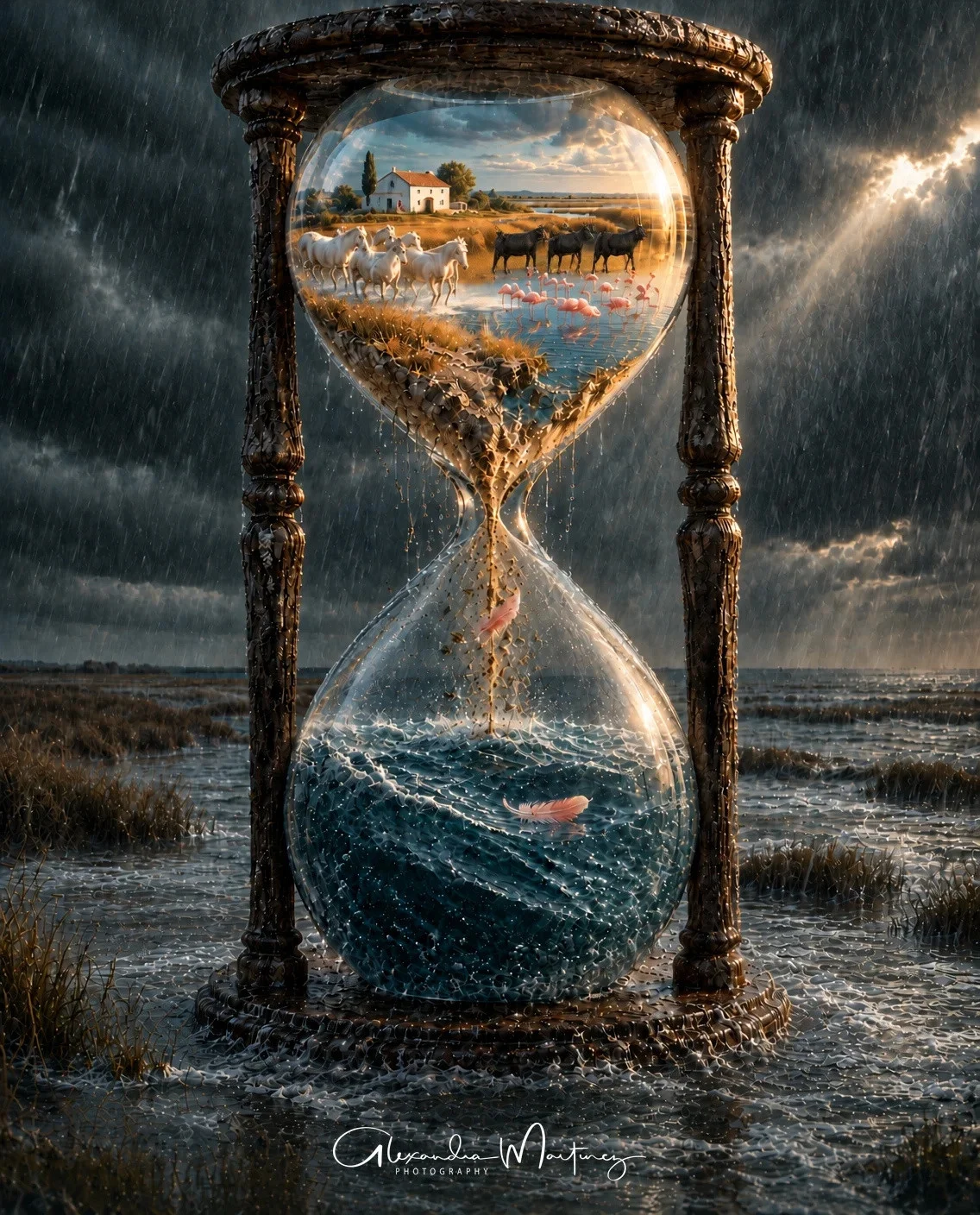
AI artwork, Alexandra Martinez
This week I got stuck on one picture on fotocommunity. Humans standing in a glass case in a museum, like an extinct species, and in front of them robots looking at them. Clearly made with AI, and brilliant, because you understand the whole idea in a second.
So I wanted to know how something like this is made. And whether I could manage it with the Camargue.
From rain to hourglass
The first idea didn't work. Birds photographing a photographer in a hide: I didn't understand it myself without an explanation. If you have to explain an image, it doesn't work.
The second idea came from the weather. It has been raining a lot here lately, the fields are under water, the water in the marshes is rising, horses and bulls are standing in the wet. That became an hourglass. In the upper glass is everything I love about this land, the sunny Camargue with its white horses and flamingos, and it slowly trickles down while a storm rages outside.
The idea worked straight away. The details were another story.
What the AI couldn't do
I wanted a cabane de gardian, the traditional whitewashed hut with the thick reed roof and the rounded back end. Three times the AI painted me an ordinary cottage with a pointed gable. It is still in the picture. If you look closely, you'll see a house that doesn't belong in the Camargue.
Then the bulls. Camargue bulls are black and lean, and their horns curve upwards like a lyre. The AI turned them into tiny black dots. I only got proper bulls into the hourglass by a detour: first a separate image of the bulls, then that image as a template.
Despite my description, the AI didn't reliably capture the typical features of the Camargue.
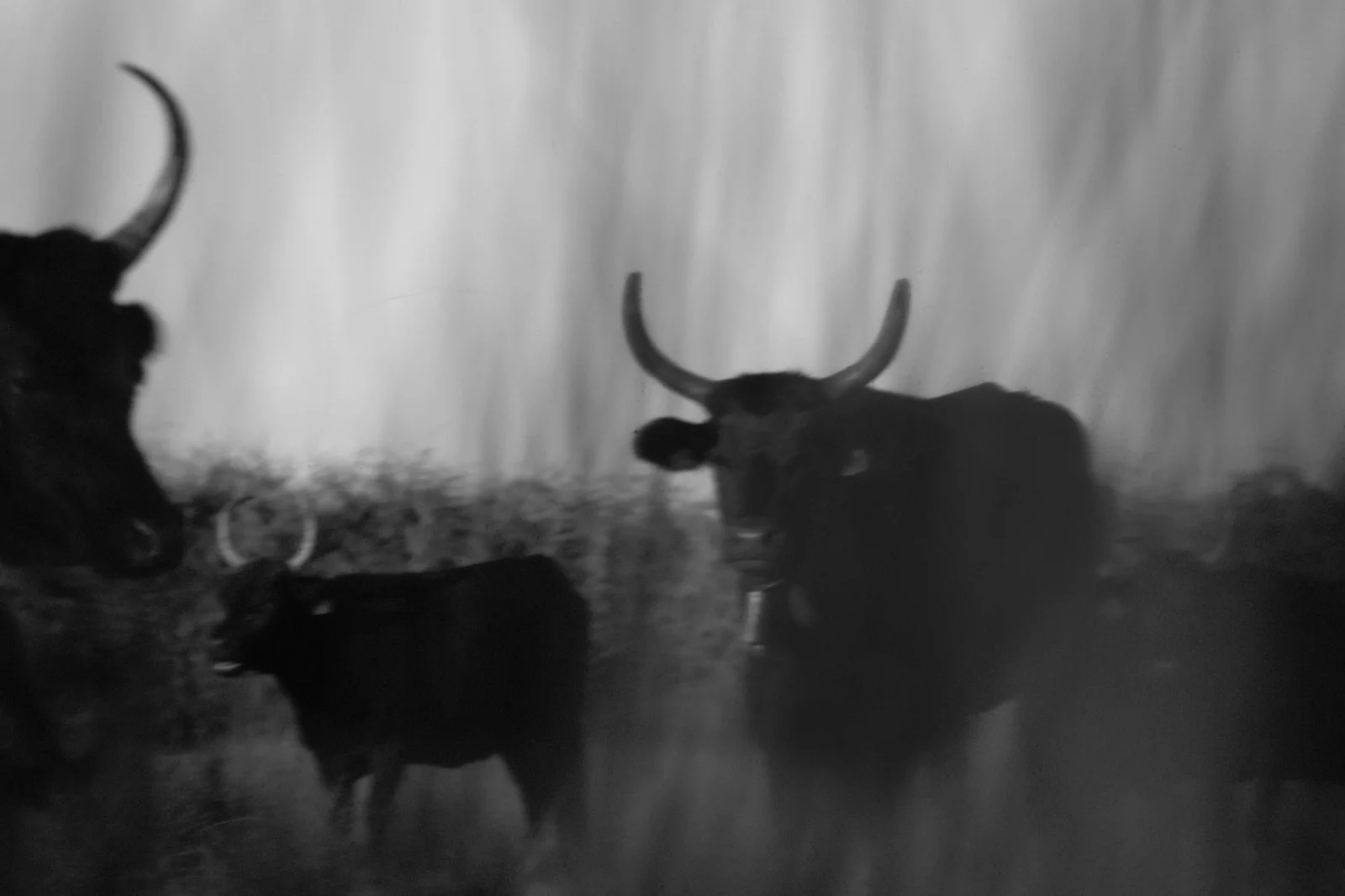
This is what Camargue bulls really look like. Photo: Alexandra Martinez
The video shows the finished image with my text. It was ready within a few minutes.
Where my limit is
Making the image was exciting, and it carries a message I couldn't photograph like this, at least not without a huge effort. But it was an experiment, and it will stay an exception.
For my own photos, I use AI when editing, to reduce noise and to remove lens flare or small distractions. My limit is somewhere else. In my photographs there are no invented animals, no swapped landscapes, no artificially generated skies and no artificially created moments. The animals and the moment were there when I pressed the shutter.
AI in the office? Yes.
Where AI really helps me is somewhere else entirely: in the daily office work that comes with Camargue Photo Hides. Planning workshops, keeping track of bookings and dates, bookkeeping and filing. For that, I find it really good.
And you? Is AI a curse or a blessing for photography? I'd be glad to hear from you.
And if you'd rather photograph the real Camargue yourself, come to one of my workshops. We spend time together and photograph together, without any AI. Instead, you go home with lots of beautiful memories and real photographs.