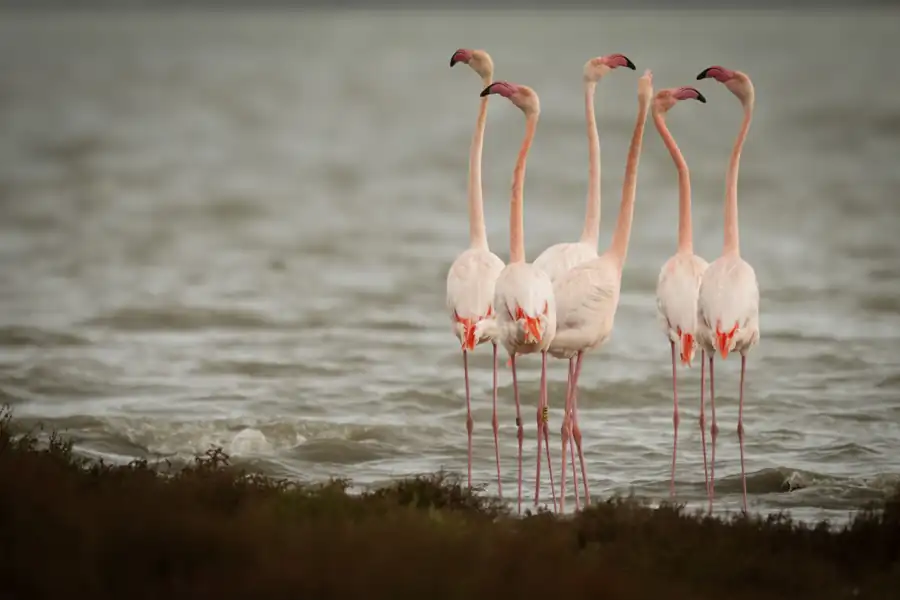
One of the most fascinating spectacles for nature lovers and wildlife photographers in the Camargue is the courtship of the greater flamingos. On 8 November I was able to watch them courting: a group marched through the water with their necks stretched up, turning their heads from side to side. Then they spread their wings and showed their beautiful colours. Here is what happens during courtship, why flamingos are pink and how I photograph them.
The flamingo dance
You usually hear them before you see them: a loud, excited chatter, and then the group starts to move. Males and females take part together, in large mixed groups. They march from one side of the marsh to the other, turn their heads in sync and stretch their necks as far as they will go.
During the wing salute they open their wings and show the most intensely coloured feathers. At this time of year the plumage is at its brightest. Research in the Camargue has shown that the displays become more varied with age, and flamingos tend to choose experienced partners.
A pair stays together for one breeding season. The next year, most flamingos choose a new partner. The female lays a single egg on a mound of mud, and both parents incubate it for about 30 days. After hatching, the chick is fed with "crop milk" produced by both parents. Even when it can walk and swim, the young flamingo is fed by its parents for around two more months, until its filter bill is fully developed.
Why are flamingos pink?
Flamingos are not born pink. The colour comes from their food: the small crustaceans and algae they filter out of the water contain carotenoids, the same pigments that make carrots orange. Without them, the feathers would stay pale.
During the breeding season they add something extra. Flamingos have a preen gland at the base of the tail, and its oil also contains carotenoids. In courtship season they spread this oil over their feathers more often, which makes the colour stronger. Researchers call it flamingo make-up.
Chicks have grey down, and young flamingos stay greyish-white for a long time. Most only have their full adult plumage at around four years old. So if you see a grey bird standing next to a bright pink one, it is not a different species, just a younger flamingo.
The flamingo year in the Camargue
- November to March: courtship in large groups.
- Spring: pairs find a spot in the breeding colony and build nests out of mud. The breeding colonies are in the salt pans: for a long time mainly at the Étang du Fangassier near Salin-de-Giraud, in recent years mostly in the Salins d'Aigues-Mortes. They are protected and not open to visitors.
- Usually April: the female lays a single egg. In some years laying happens later.
- About 30 days later: the chick hatches, usually in May.
- After about 10 days: the chicks leave the nest and gather in a large nursery group, the crèche.
- Late July or early August: the Tour du Valat rings the chicks.
- At about 80 days: the young fledge, usually in August or September, and then disperse.
Where to see it
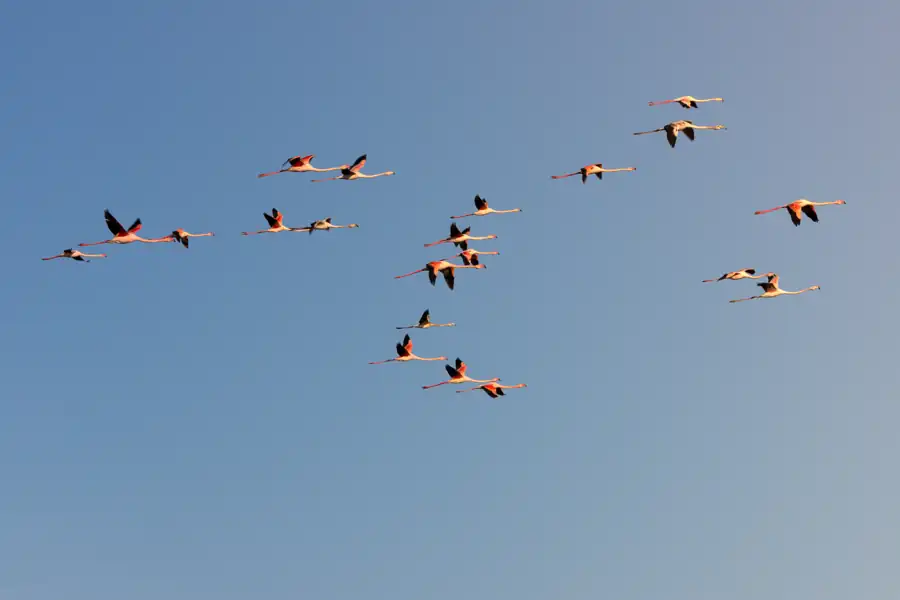
On my own wetlands the flamingos are regular visitors. Early in the morning, when the first warm light reaches their plumage against a dark sky, is my favourite time. Flamingos are shy, but if you move slowly and watch their body language, you can get very close. If you like, I can also take you to the best flamingo spots in the Camargue myself. Your best chance of photographing flamingos is at the Parc Ornithologique du Pont de Gau near Saintes-Maries-de-la-Mer. The flamingos are fed there early in the morning. The birds have learned this quickly, so you can count on them being there in the morning. But you can also watch them in the marshes around Saintes-Maries-de-la-Mer.
How I photograph flamingos
Go low. I like to photograph flamingos from a low angle, close to eye level. The water becomes a soft foreground, the background moves further away, and the birds look taller and more elegant. I photograph flamingos at different places in the Camargue, and wherever I am, I try to get as low as possible.
Leave space. You don't always need to zoom in tight. A single flamingo with a lot of water or sky around it often tells more than a full-frame portrait. Negative space works best when the empty area is calm: smooth water, a reflection, a soft colour gradient in the sky.
Give them room to look and walk. Place the bird off-centre and leave space in the direction it is looking or walking. With a marching group, leave room in front of the first bird, so the movement has somewhere to go.
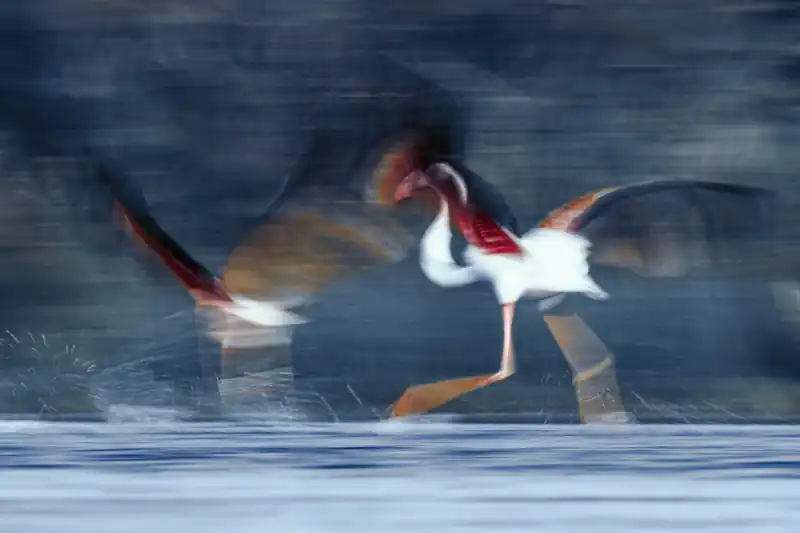
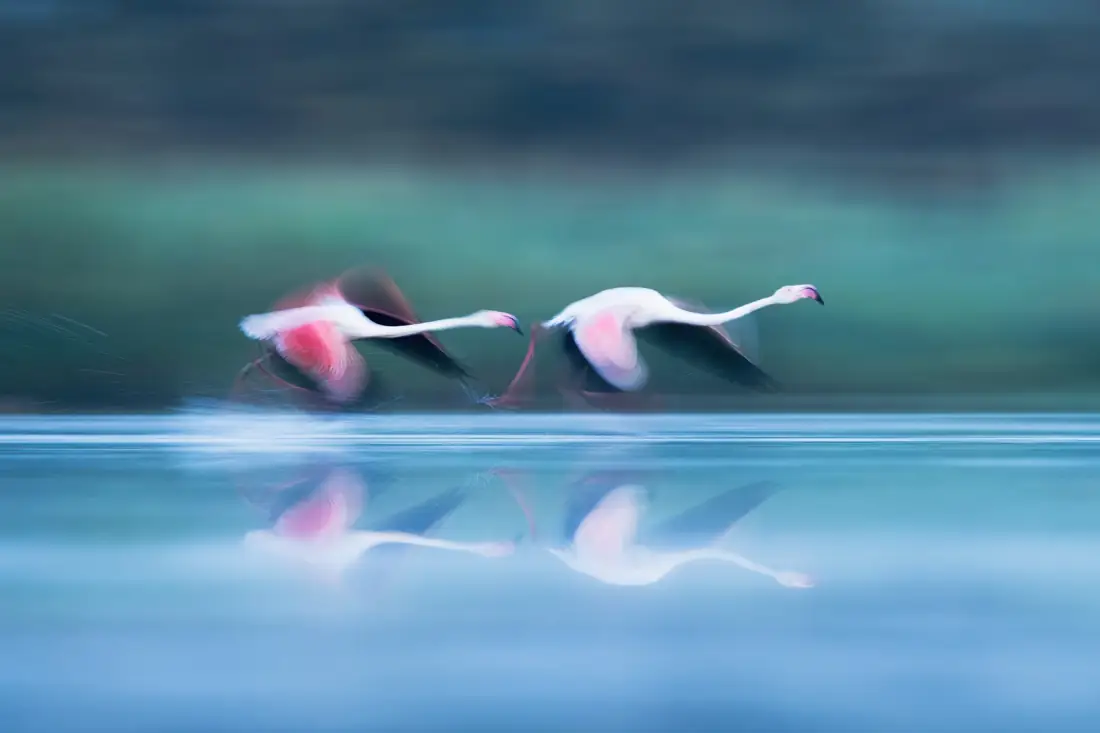
Try a pan. I love panning shots, and for flamingos I use 1/20 s. Follow the moving bird with the camera and keep moving while you press the shutter. The bird stays sharp enough, while the background turns into soft lines of colour. Not every frame works at such a slow shutter speed, so always shoot a series.
Look at the legs. Many flamingos in the Camargue wear a coloured ring with a code. With a long focal length you can often read it on your photo. On the title image of this article, one of the birds wears a yellow ring. The colour tells you where the bird comes from: dark blue rings with a white code are from Italy. Light rings, white or yellow, with a black code come from France, Spain, Sardinia, Turkey or Algeria. The structure of the code shows which country exactly. Over the years, white rings can turn yellow and yellow ones white. You can report the code, with the date and place and ideally a photo, to the Tour du Valat (tourduvalat.org). This research station in the Camargue has ringed flamingo chicks every year since 1977. The reports make it possible to follow each bird individually: where it hatched, where it travels and how old it gets.
What else late winter has to offer
February and March in the Camargue are unpredictable: morning mist that lifts slowly from the fields, rain or mistral, and then bright blue skies with spring-like temperatures. It is noticeably milder than in northern Europe. The big advantages: hardly any mosquitoes, hardly any tourists, and the sun rises late enough for relaxed sunrise sessions by the sea.
Many birds stop over on their way north from Spain and Africa. Above all, common cranes can be seen in their thousands, feeding on the fields in large flocks or in small family groups. In the reed beds you can find bearded reedlings all year round, as well as purple swamphens, glossy ibis, herons, harriers and kites. Bee-eaters and rollers only arrive later in spring.
FAQ
Are flamingos in the Camargue all year?
Yes, you can see flamingos in the Camargue in every season. What changes is their behaviour: the courtship displays are the time when they are most active and most colourful.
When is the courtship?
From November you can watch the courtship, until early spring. This year I saw them courting on 8 November.
Why are some flamingos grey?
They are young birds. Most flamingos only reach full adult plumage at around four years old.
How close can I get?
At the Parc Ornithologique du Pont de Gau you can get very close. In the wild, for example by the Vaccarès, the flamingos fly off as soon as you walk towards them. Camouflage helps there. Move slowly, keep low and watch their body language.
Would you like to photograph the courtship yourself? You can join me in February 2027 for the Camargue Winter Experience and in March and April for the Early Spring Wildlife Intensive.
Read more: Photographing birds from a floating hide in the Camargue · When to photograph birds in the Camargue – a month-by-month guide · Bird photography in the Camargue