Long before I picked up a camera, I was the child who stopped for every buzzard on a fence post. Raptors and owls have always been my favourite animals: the way a hawk sits utterly still and then explodes into flight, the way an owl turns its head and looks straight through you.
A love that started early
Living on the Étang du Vaccarès, I see birds of prey every day: harriers quartering the reeds, kestrels hovering over the meadows, owls calling at dusk. (If you are curious when which species is around, have a look at my month-by-month guide to the birds of the Camargue.) At some point, watching was no longer enough.
The long road to the fist
In France you cannot simply buy a bird of prey. First comes the permis de chasser, the French hunting licence, which is compulsory for anyone who wants to acquire a raptor for falconry. I passed mine in February. Before and after that, I spent months learning alongside an experienced falconer. Falconry is a craft that is handed down in person: no book can teach you how to read a hawk's mood.
The next step was the autorisation de détention, the official permit to keep birds of prey. With it, I am now allowed to keep up to six raptors for chasse au vol, the French term for hunting with trained birds. I decided to start with two.
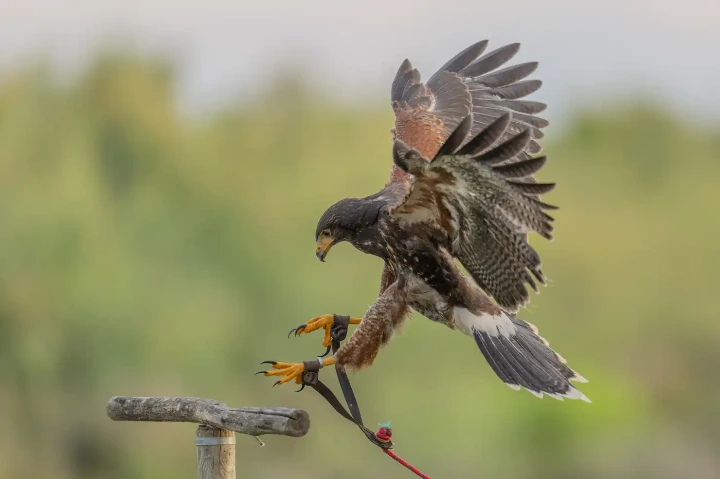
Photo: Dirk Koster
Tina and Elvis
Both of them came to me as five-week-old chicks, and I have raised and trained them myself from the very beginning.
Tina is a female Harris's hawk. Harris's hawks are the most sociable of all raptors: in the wild they even hunt in family groups, which makes them unusually cooperative partners for a falconer. Tina is a natural for bas vol ("low flight"), the style of falconry in which a hawk is flown straight from the fist, the falconer's gloved hand, at prey close to the ground. Its counterpart is haut vol ("high flight"), the classic falcon style, where the bird climbs high and waits on above the falconer before stooping (diving) at its quarry.
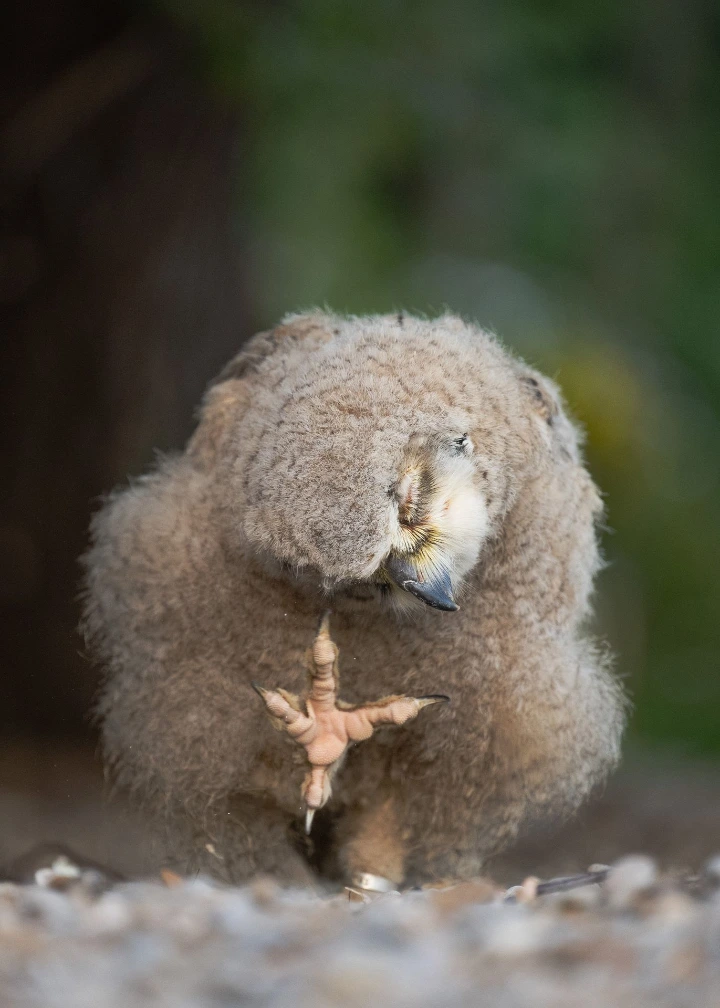
Elvis is a Eurasian eagle-owl, and he lives up to his name. Eagle-owls are famously headstrong and among the hardest raptors to train. Every step with him takes patience, and then more patience. Where Tina asks "what are we doing next?", Elvis asks "why should I?"
The daily routine: scales before skies
What most people never see is the quiet work behind every flight. Each day begins on the scales. I weigh Tina and Elvis every morning, to the gram, and write it down. In falconry, weight is everything.
Every bird has its flying weight, the weight at which she is healthy and strong but also keen to fly and hunt. If a hawk is too heavy, she is "fed up": content, lazy, and much more likely to sit in a tree and ignore you, or to drift off for good. If she is too light, she loses strength and condition. The art lies in finding that narrow window and keeping her in it, day after day, through heat, Mistral and winter cold. When everything is right, a hawk is sharp-set: alert, eager and focused on the fist. The old falconers' word for a hawk at the very peak of her hunting mood is yarak.
Weighing is only the start. Every day I also check:
- Feet: clean, with no swelling or sores. Healthy feet are vital for a bird that lives on her talons.
- Feathers: no broken or damaged feathers, because she needs every one to fly well.
- Mutes and castings: a hawk's droppings, and the pellets of fur and bone she brings up after a whole-prey meal. They tell me a lot about her health and digestion.
- Behaviour: how she sits, how she reacts, whether she seems relaxed or stressed.
Between flights the birds rest in their mews, their sheltered aviary, or sit out weathering on their perch in the fresh air and sun. It is a daily rhythm of care that never takes a day off, and I love it just as much as the flight itself.
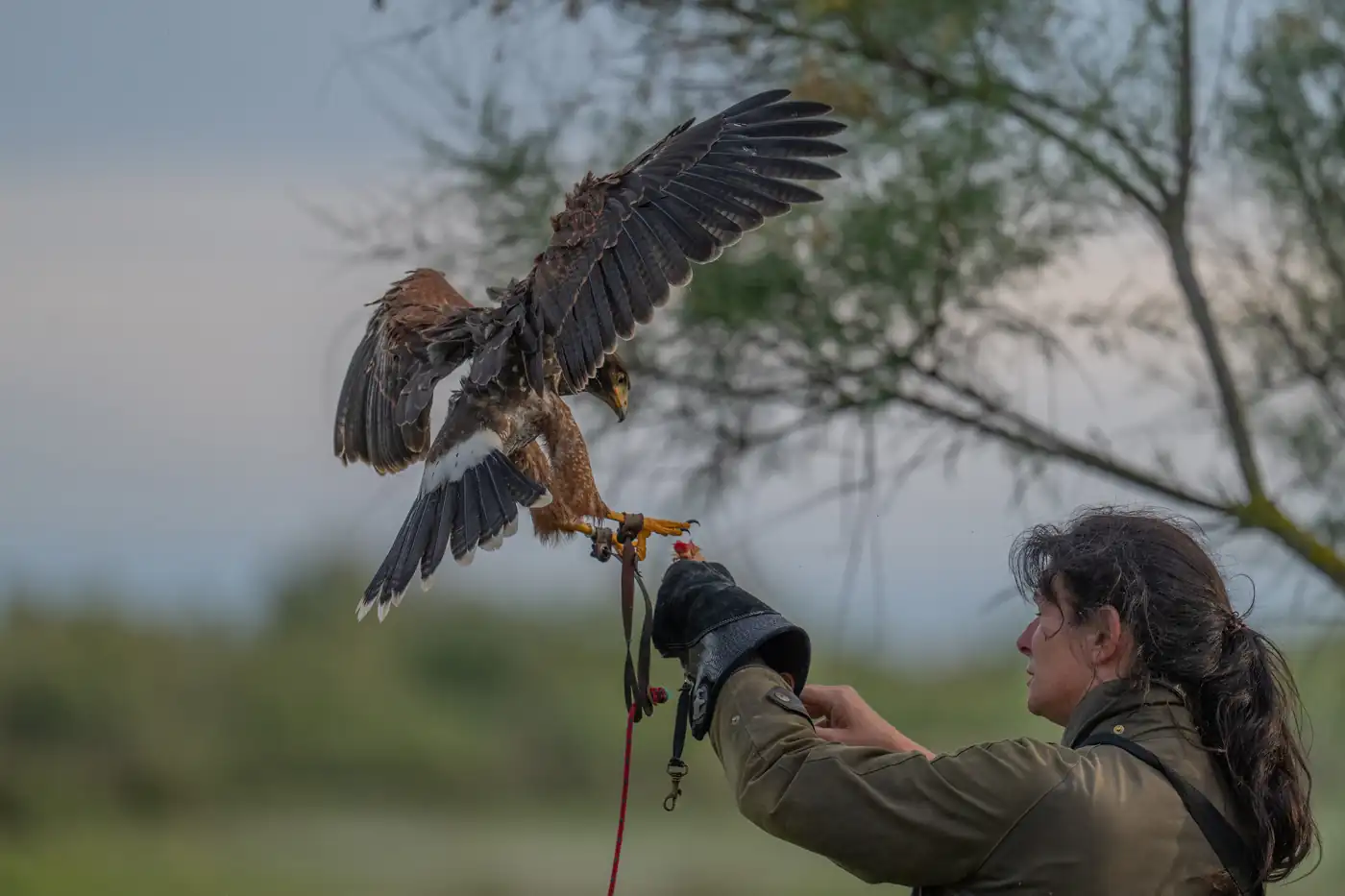
Photo: Dirk Koster
The first free flight
Every young hawk starts on the creance, a long, light training line attached to the bird so she cannot fly off while she learns to come back to the fist or the lure, a bundle of feathers or a piece of meat on a cord that the falconer swings to call the bird in. Day after day she flies a little further, always on the line. Then comes the day you take it off.
In early October I did exactly that. I cast her off (released her from the fist) and she flew free over the mas, across the meadows, with nothing holding her to me. And then she came back.
I cannot describe how that feels. A hawk you have raised since she was five weeks old, who could go anywhere, and who chooses to return to your glove. That is not obedience. It is trust, freely given, and it is the most beautiful feeling I know.
Why I see falconry as the most natural way to hunt
Our next goal is Tina's first real hunt. People are sometimes surprised that I, a wildlife photographer, want to hunt at all. But for me falconry is the most natural form of hunting there is:
- It is nature's own way. The hawk hunts exactly as she would in the wild. I do not kill anything; I simply give her the chance to do what she was made for.
- The prey has a real chance. Most flights end with the quarry escaping. Rabbits and pheasants have evolved alongside hawks for millions of years. They know every trick, and they often win.
- There is no wounded game. A flight ends in one of two ways: the hawk catches her prey, or it gets away unharmed. Nothing is left injured in the reeds.
- It follows natural selection. Like wild raptors, a hawk most often catches the weak, slow or sick animals, which keeps wild populations healthy.
- It is quiet. No shots, no lead in the marshes, no disturbance for the other wildlife around us.
- It is a partnership. A hawk cannot be forced. She hunts with me because she wants to, and every flight depends on our trust.
Falconry is one of the oldest ways in which humans and animals have worked together, and since 2010 UNESCO has recognised it as an intangible cultural heritage of humanity. For me it is simply the closest I can come to the wild life I photograph every day: not as an observer behind a lens, but as a part of it.
A small falconer's glossary
- Fist: the falconer's gloved hand, the hawk's home base.
- Bas vol / haut vol: low flight with hawks from the fist / high flight with falcons that wait on high above.
- Chasse au vol: the French term for falconry, hunting with trained birds of prey.
- Quarry: the prey a hawk is flown at.
- Creance: the long training line used until the bird returns reliably.
- Lure: a feathered or meat-baited bundle on a cord, swung to call the bird back.
- Cast off: to release a hawk from the fist into flight.
- Flying weight: the weight at which a bird is fit and keen to fly.
- Sharp-set / yarak: keen and ready to hunt / at the very peak of hunting mood.
- Fed up: overfed and unwilling to work.
- Mutes / castings: droppings / pellets of undigested fur, feathers and bone.
- Mews: a raptor's sheltered aviary.
- Weathering: time spent outdoors on the perch in fresh air.
Want to follow Tina's first hunt?